hckrnws
I found this bit interesting:
> Basically, one reason I’ve lost a lot of will to do anything is because of AI’s existence, and I don’t want to use it. Because I have zero personal time, zero time whatsoever to do anything, so sometimes I’m thinking, “Oh, I could do this task or that task so much faster if I used AI,” but I don’t want to use AI, so then I don’t want to do the task at all. So I don’t have the time to sit down and model something because I know there is a faster way, but I don’t want to use the faster way, so the thing doesn’t get done.
I'm not completely sure, but I think her reasoning is that AI made it a lot easier for random people to just have the idea and translate it into an image in a minute or two, and this cheapens the whole experience for her, to the point that it no longer seems worth doing.
It's sort of a funny point. I think most painters are happy that they don't have to go out and grind up snails to make their own purple pigment, but are perhaps less happy if somebody can produce a painting indistinguishable from their own effort with no manual handwork skill at all. It's like there's a minimum threshold of human skill and investment for an object to be interesting beyond its pure functionality, and functionality has little to do with art (but a lot to do with, say, software).
I actually don't think her reasoning has to do with other people at all. I think it's that given she wants to make an image of a poorly designed object, she knows she could either do it herself, or she could do something that takes 99% less effort but produces a result that's 90% as good. Her brain says "the easier way is obviously more efficient, clearly that's what you should do". But using AI isn't actually a satisfying process so even though it's way easier, she doesn't have a desire to do it. Of course the option to do it the way she's always done it is still there and would be just as satisfying in the end. The difficulty is that now there's a little part of her brain that would be going "you're acting inefficiently/irrationally", which just makes the process less pleasant and harder to convince herself to continue with. To me it seems like
I know I have experienced this, and I bet a lot of people here have experienced this, with writing code by hand vs having Claude do it. I genuinely enjoy writing code, but now to get that joy, I have to commit to writing code _for the sake of writing code_, since it's no longer necessary to do it to achieve the end goal I have.
That's how I read it too, and how I relate to it.
I have the exact same feeling as you towards coding AI for hobby projects. Though this sentiment isn't new, and AI is just a detail.
I'm not a musician, but I'm attracted to synthesizers and bought a couple in the past just for fun. I immediately get caught in a quicksand of DAWs and plugins and whatnot, which kill the fun for me (it's too similar to work), but at the same time I can't ignore the tools because now the synth is too "bland".
It's a weird kind of FOMO paralysis.
I think you are incorrect in assuming that the reason she doesn't want to use AI is because of democratization. She is pretty clear about her reasoning; she enjoys the effort of her work, and removing the effort removes the joy.
In fact if we're being honest, there is some weird unprompted bitterness in your response that is pretty common in the AI space. Creatives who don't like AI are always haughty elitists who don't like that the peasants can now create works as brilliant as them.
In reality, most artists I know wouldn't use AI because the friction is part of the joy of creation for them. Or maybe they want to feel like the work truly emerged from their own brain. Or they find their art practice both productive and meditative, and those are equally important to them. Or numerous other reasons, mostly compelling.
I'm not an artist, or even particularly creative, but the only reason I would undertake any hobby is because I enjoy the process. I like building Gunpla models, which seems irrational if you are only thinking about output. If someone were to say to me, "You know, they sell plastic toys of the RX-78-2. You could just buy one if you wanted it," I would stare at them blankly.
> In fact if we're being honest, there is some weird unprompted bitterness in your response
Politely, I suggest that prefacing a claim about a stranger's emotions by saying that the claim is "fact" and "honest" is presumptuous.
But I do think you're right about the "friction [being] part of the joy". I think a better version of my comment is that enjoying those frictions isn't completely straightforward, and the temptations of a frictionless (and maybe subpar) alternative make those frictions less enjoyable still, as simonbw's comment observed.
> the friction is part of the joy of creation for them
I’d extend that to suggest—based on conversations with the artists in my life, anyway—that for many, the friction along the path from an idea to a work is where the art happens in the first place. That the art happens in the additions and subtractions and judgments the artist makes along the way as they bring the artifact into being. That without that, it’s something closer to manufacturing.
I’m reminded of how we around here grumble at piles of vibe-coded slop, even if they notionally solve the users’ problems at hand. It’s not strictly that “it’s insufficient at satisfying the problem brief,” it’s that it’s missing all the other latent considerations—structure, coherence, legibility, maintainability, determinism, good judgment—that a skilled code craftsperson would have worked in along the way almost without thinking.
Depressing for artists of code itself—liberating for the people whose artistic practice is maybe one level of abstraction up—whose obsession is iterating through “finished” products til they fit just so, til they reflect the high-level intention just right. For whom the code part was always an annoying-but-necessary slog, akin to, as another commenter said, grinding the snails for pigment…
“I dread what it means for the code base at work, but damn if I’m not cranking out every single side project I’d never gotten around to…”
Comment was deleted :(
A similar thing happened in the early days of 3D printing. When hobbyist 3D printing started you needed to be skilled and tenacious enough to build a 3D printer and tune it well enough to print.
Then as companies like Prusa and later Bambu made 3D printing more and more accessible to the masses there was a subgroup of 3D printing fans who were unhappy about the change. They lost interest in the hobby. Some became bitter and spent their time finding things to complain about on Reddit and other forums instead of enjoying their printing.
Logically, enabling other people to produce something shouldn’t subtract from others’ enjoyment of their own hobbies. Many still do woodworking with hand tools even though we can buy factory furniture now.
I think some people are more interested in seeking status and doing things for personal branding reasons than the joy of the hobby itself. For that group, any advancement that makes it easier for other people to do something similar to what they do (even if lesser quality, as is often the case with AI) it interferes with their ability to use that hobby for status. They carved out a niche as the person who did something rare or semi-unique, but making that thing accessible to more people took that away. So their motivation wanes.
I've repeatedly told people you ignore AI at your peril.
I had the same experience when I was a front-end dev and all the JS frameworks were getting big. I didn't want to use them, I tried to stay away from them as much as I could. I reluctantly learned Angular after being put on a project where they were using it. After 5 years, I wanted to leave my company and started looking around for dev openings. Whoops. Literally every front-end dev role was now "full stack role" and unless you knew ReactJS or one of the other now common JS frameworks in depth, you had no options. I was able to pivot into a few other roles that were essentially front-end related, but have yet to get back to doing dev work unless its on my own hobby time at home.
I completely removed myself from an industry because I didn't want to change with the industry I spent ten years making a career from. Now with this new wave of AI, I know better. I don't like AI, I think companies are already using it recklessly to pad their bottom lines, but I've seen this movie before. Now I keep pace, I use it at work, I vibe code at home, I create agents and use MCP servers, I work constantly on learning to create better prompts.
Maybe she hasn't been sidelined by a technology yet in her career, but someone told me recently, "AI may not replace YOU? But someone who can use and know AI very possibly could replace you." This same thing is happening in the art world. Unfortunately, either you figure out how to leverage it to stay in the industry, or get passed up by people who are using it to do what you used to do and find yourself too far behind to ever catch up.
Comment was deleted :(
> I think most painters are happy that they don't have to go out and grind up snails to make their own purple pigment
People who loved mixing colors enough to become experts may have been disappointed when their hard-won skills were rendered obsolete by the march of progress.
There are some aspects of my work that are enjoyable on their own and others that I only do because they're necessary overhead to achieve a desired result. I appreciate technology that eliminates the latter but lament technology that eliminates the former.
So when AI obsoletes yet another human skill I suspect a lot of the wildly different emotional responses are dependent on whether someone considers the skill being obsoleted more "enjoyable" or "necessary overhead".
This reminds me of the time I really wanted an FT-86 (Toyota low end sports car). I spent ages researching them and reading reviews and stuff. Then they started to get popular and I’d see them everywhere and I kinda didn’t want one anymore.
I described this to a friend and he turned to me, shocked, and said “you’re a sports car hipster!” And I’ve never been quite the same since.
My first thought is that this is a sign of burn-out.
There's a certain kind of bad taste that goes with AI art like there was with NFTs.
Oddly a few months ago somebody who was a few years too late DMed me on Tumblr to say he wanted to make NFTs of my photos. I played it cool and eventually asked him "which ones do you want?" which got him to pick the last 5 I posted which proves he isn't even looking.
Nextdoor for a nearby city lately has been spammed my somebody who makes AI slop videos with senseless motion like a bad Instagram Reel about our police department (he's black but seems to love the blue) -- at least he has some sense of praising vs dissing people but to people like that there is not difference between beautiful and ugly, good and bad, just ceaseless motion that never stops.
[dead]
That quote is so relatable lol.
You assumed it is about effort, and not quality.
Are you aware that without explanation you just assumed things can be achieved with less effort without quality degradation?
[dead]
Such badly designed products are easy to spot by visual inspection.
Unfortunately, if you go shopping in a supermarket or online, you can find a huge amount of bad products that look like they were well designed, but in reality some of their parts are made from wrong materials, and you discover this only at home, after using them for a few months, or for a few days, or even after a few minutes.
For instance, I have seen devices where pressure-regulating springs were not made of spring steel, but of ordinary steel and they lost their elasticity after a very short time, making the device unusable, water buckets supposedly made of stainless steel that were actually made of chromated steel, which rusted at joints after a few months and a lot of diverse devices where parts that suffer cyclical stresses are not make of a fatigue-resistant material, so they break after a short time of use.
There are countless examples of this kind and all have this problem that you cannot detect visually if the correct materials are used, or not, like you can recognize an inappropriate shape.
It reminds me of "bazaar" shops I lived next to at some point.
They had all sorts of cheap objects shaped like simple household items. Obviously, you don't expect premium quality when you buy these things, but you expect it to at least have some function, but they manage to fail at the most simple things. Examples:
- Sewing needles with the eye too small to fit a thread into, they also bend as easily as a piece of wire
- Tubes of "super glue" that are mostly empty, also when you press on it, it all goes on your finger instead of out of the nozzle
- Screwdriver bits with tolerances so loose they don't even fit the screw, some even had bubbles inside, like swiss cheese
- Packing tape that doesn't stick to carboard, at all
- Steak knives that break at the handle as soon as you start cutting steak with them
- "squares" that are off by more than 1 degree
Sometimes the world changes such that two parts of a process that used to be tied together are unraveled into separate practices. Technology always plays a part in this, but AI is driving this process in many fields now in a way that is outside the bounds of what we were prepared for mentally.
Usually this happens slowly enough over time that we can adapt to it sociologically or generationally such that we don't see or feel the pain so distinctly. There likely were people that were upset when commodity paints were introduced because, for them, part of painting was creating your own palate of paints. Of course, you can still do that even today, but it is no longer necessarily tied to the process of painting.
This is happening in areas that we didn't anticipate it happening and happening to a bunch of them at the same time. Ignoring point-in-time AI model quality meaning that a given output is 50, 80, 95, or 99, 100, of 120% as good as a human, we have the ability to use AI now to achieve outcomes in many fields that required some sort of craftsmanship to achieve prior.
People who enjoy the craftsmanship are understandably shaken up because their craftsmanship has been drastically devalued. Some people simply want to achieve the outcome and were previously frustrated by being gatekept by not having the skill or experience that craftsmanship demanded and they are now thrilled to be able to do something they couldn't before. Both of these are understandable experiences and exist/live together without contradiction.
This gets quite close to chindogu, the Japanese art of designing objects that kind of serve a very niche purpose, but then without being useful. https://www.tofugu.com/japan/chindogu-japanese-inventions/
Funny how some of those ideas are obviously useful, some I even see in stores... and then turns out the selfie stick is an example too, which makes one question the whole categorization.
I like the iPhone Control Center screenshot in there…
I would spend an extra $0.20/lb if my butter came in a stick (though I think the form factor should emulate deodorant and not chapstick) and would shamelessly rock the umbrella tie.
Butter already comes in a stick. It's called a butter stick!
Peel the wrapping from one end; and just like that; you got a big butter stick-stick!
Is it time to model and 3D print a butter-stick stick-pusher? With a little battery and heating coil at the sticking out end. Getting a slightly soft and sticky enough butter out of the butter-stick-stick without it sticking to the stick? What a buttery sticky thought.
i need a roller desk EV.
I’ve always enjoyed the “useless teapot” that Don Norman has on the cover of DOET: https://images-na.ssl-images-amazon.com/images/I/61KtiLw7BtL...

I believe it is actually called: The masochist’s teapot.
I recommend this book to anyone remotely interested in design. Even today it is fantastic.
Reading it was a watershed in my life.
I never look at doors, without evaluating their usability, anymore.
I bought a new door for my house recently. When the salesman asked what type handle/knob I wanted, I had a bit of an internal crisis. The one he said post people got seemed like it would create a Norman door, which I desperately wanted to avoid. I ended up getting a standard knob to avoid being the absolute lunatic who spent 6 hours debating the merits of various door handles, but had I been alone, I would have absolutely done that. I still feel like I made a mistake every time I look at my door.
The book was a gift and a curse.
The whole doorknob thing in the US is a mystery to me, doorhandles/levers are so much easier to use.
In some places, levers are required (ADA thing).
yeah, the book is something that people hate me having read. I know it wasn't my mistake and I tell them that.
as for door handles, most manufactures use interchangaple knobs so you can buy two and swap. You end up with a useless mechinism (i find you rarely can find a different door that needs the reverse handle)
If the cap is screwed on and sealed, you should pour it from the side like a bottle of oil: https://www.team-bhp.com/forum/attachments/technical-stuff/1...

I guess you use different types of teapots, the ones I ever saw were definitely not waterproof, nothing to screw. Maybe some small lip to keep it in place but when put on the side they would probably fall off, pouring hot liquid everywhere.
this really reminds me of the "worst volume control" from reddit https://uxdesign.cc/the-worst-volume-control-ui-in-the-world...
The "cannon" one is maybe the funniest thing I've seen on the internet in months. It almost makes me want to add autoplaying music to my own website, just to add that too.
IC: With AI getting bigger and more controversial and so on, have you used AI to create any of these designs?
That is an interesting point to bring up, because this type of "almost but not quite right" is exactly what AI seems to naturally create.
I think the difference is AI images tend to create mush or impossible geometry. The ideas here where a minimal change to the design renders the item entirely unusable takes a fair bit of creativity.
"what if objects were actually designed for a bad user experience, instead of a good one? she recalled in a 2018 TED talk. That was my ‘eureka’ moment."
Or, she stumbled upon some article or the very Wikipedia page about it:
Or you could believe what she said instead of implying that she's lying??
You can see some of these objects at Musée des Arts et Métiers: https://www.arts-et-metiers.net/musee/les-objets-inconfortab...
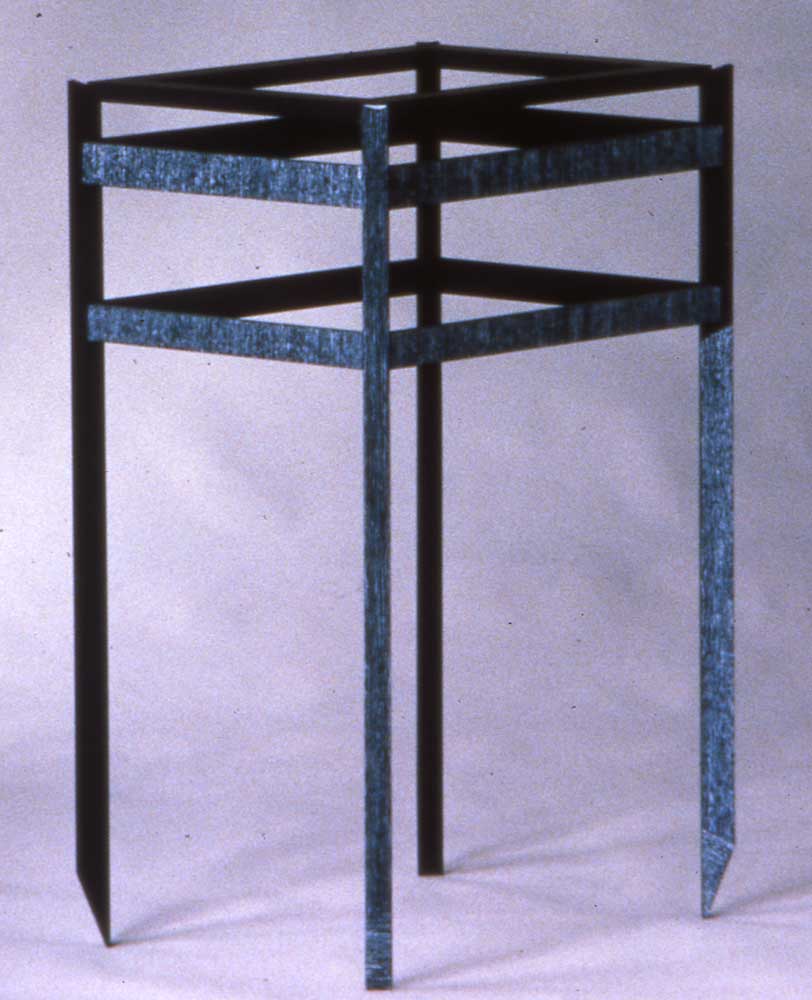
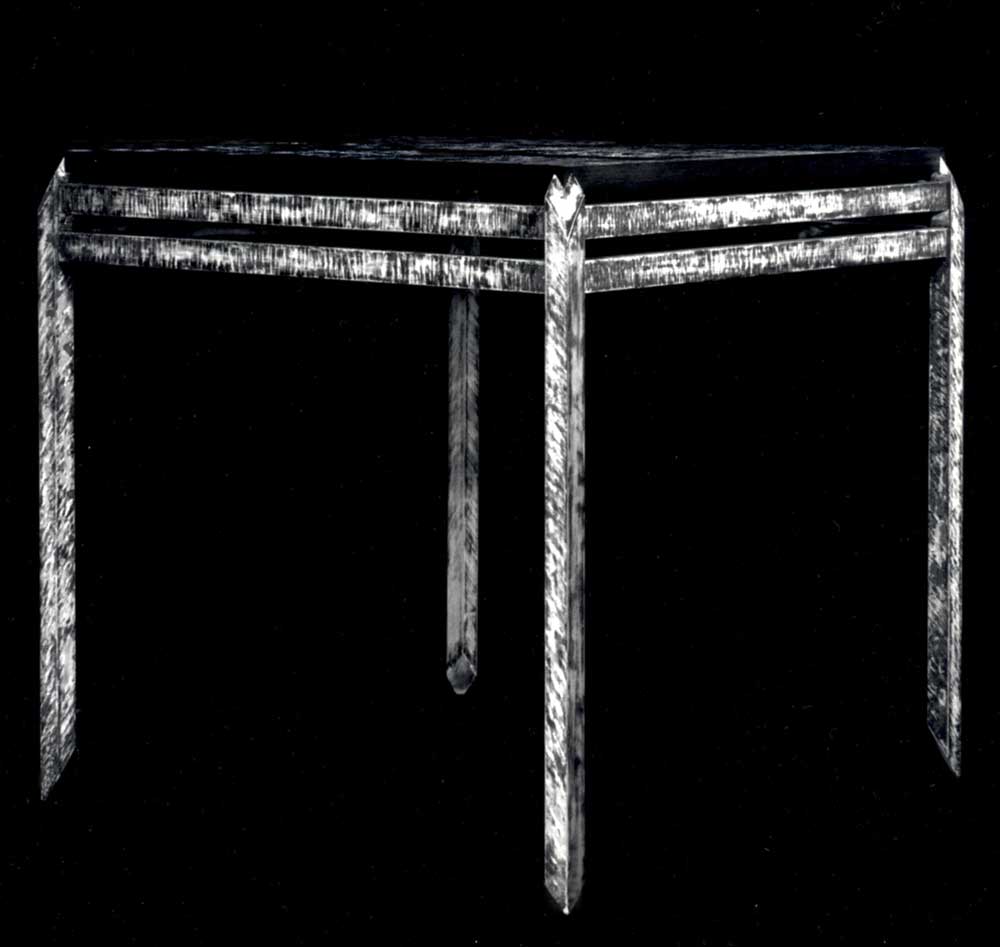
for the record, I am a furniture designer class 1985 Primrose Center and I made a table without a top to demonstrate this point: https://www.jeisch.com/img/furniture/tab_no_top_1988.jpg and another one which is a table which is a holder for a painting: https://www.jeisch.com/img/furniture/tab_pointy_1987.jpg the painting which is being held in the pointy table is this: https://www.jeisch.com/img/paintings/oil_martyr_1988.jpg but it slides in and out basically it is a horizontal holder a painting.

I love that these are all fairly beautiful, stuff you'd really love to have if it wasn't fundamentally unusable.
It really highlights how much we associate "good design" with aesthetics first, even though function is doing most of the heavy lifting
The double glass (not in the article, but on her website) would actually be kind of romantic. Still impractical, but romantic.
This is a link to the interview. here is a link to the products website: https://www.theuncomfortable.com/#
This reminds me of Jacques Carelman's Catalogue d'objets introuvables. Highly recommended. It has already been mentioned on HN: https://news.ycombinator.com/item?id=9789216
I feel like I've seen some of these designs a VERY long time ago? Is this something old that the person was just interviewed on recently?
It’s been on HM a couple of times, first in 2017:
Yes! (The article says the project started a while back but the writer/interviewer only just discovered it)
It does do the rounds on the various social medias on the regular. The website looks interesting enough at least.
It's missing the Magic Mouse.
Or the M4 Mini power button...
on the bottom (both) WHY?
To let the user know that you shouldn't [use it while plugged in]/[bother turning it off]. I don't like the choice, but that's why.
That would still be bad design if it should not be used and charged at the same time. I often charge my Logitec wireless mouse while using it.
These would fit well in the Codex Seraphinianus.
Now I’m wondering how you could create ‘uncomfortable’ versions of simple command line tools (ls, cat, more etc.) or perhaps shells.
Emacs and/or vi, depending on your inclination, have text editors covered already, of course ;-)
Require interactivity (ask for confirmation on cat).
Output success error codes in unexpected range (see: robocopy).
Use special characters to try TUI things but leave the buffer in weird states.
Have many input params, and default to the most useless ones when nothing is passed. Make some params unnecessarily required.
Go on very long tangents for no reason in the manpage, but keep your -h message as just the list of badly named params.
Use stderr as your stdout.
---- I present to you worse-cat:
wcat notes.txt
error: --encoding is required. Exiting.
wcat --encoding=utf-8 notes.txt
┌─────────────────────────────────┐
│ About to display: notes.txt │
│ Are you sure? [y/N/maybe]: │
└─────────────────────────────────┘
y
stdout: ≈3 paragraphs
stderr: [file content]
echo $?
212
(I'll save you the manpage and worse-ls)
Well, bash offers vi and Emacs as editing modes. We're already covered on that front. Many of the parameters for ls are cryptic, making it awkward to use for anything other than routine tasks without referencing the man page. more is so limited that many people choose to use a program used to concatenation files (cat) as a file viewer. Those who don't want to reach for their mouse to use their terminal's scrollbar buffer will use less, since it does more than more. Don't bother parsing that last sentence with bison, unless you have a yacc to shave.
Easier to find uncomfortable websites. Back in the 90s with all the Flash, lots of peeps said these sites made them uncomfortable because they couldn’t figure out how to do anything. Couldn’t figure out the navigation.
I instantly recalled a site from this era and amazeballs it’s still there! Superbad.com All hail!
The lowest-key example of this is tools that enforce a particular order of arguments, or where the order of arguments carries semantic meaning. It's the worst. Please don't make me put the file name last, or first. You don't know which part of the command I'm tweaking.
jus used new ubuntu instead of ifconfig (weird name) it had ip couldnt figure from the help how to get actually show the ip
so linux is already there
Yeah, Linux has been trending to incomprehensible commands.
In terms of usability, moving to FreeBSD from Linux is quite a positive experience. Pity that hardware and software support is limited on the BSDs.
Feed all command output through AI to summarize the results instead of actually giving the results.
Results from ls would be a few sentences explaining the types of files in the directory. Add a -l on there and it will give you a general overview of the permissions and size of the files. Ex. “These are rather large files that are primarily, but not exclusively, limited to root.”
Results from cat would give a summary of the file. You’d get the same results, with some degree of randomness from more and less as well.
Using any command with sudo would provide the same type of results, but in all caps.
Trying to pipe commands together would be a slop multiplier.
This is a fun idea
Use an agent for all CLI work.
I’m pretty sure I’ve used cutlery pretty close to this in some hipster restaurants.
as a designer and innovator, i appriciete this. this gives me ideas really out of box, just to see these. amazing!
i also do this for ui and app logic: go to some Microslop service, they are all like these...sad but true
What's wrong about the glasses? I've been staring at them and trying to figure out why they're unworkable, as opposed to just a quirky pair of specs.
The sharp angle of the bridge would dig into your nose.
Comment was deleted :(
Pointy bit on the bridge of the nose.
the sharp point on the bridge is going to hurt your snout.
you don't have glasses ever, i guess?
Apple's famous wireless mouse with the charging port on the bottom would fit into that gallery without anyone batting an eye.
Comment was deleted :(
The glasses would be great for pool playing, as they would sit higher on your line of sight :)
"Snooker glasses" (with the lenses mostly above the bridge rather than mostly below) are actually a thing: https://snookerchat.com/snooker-great-dennis-taylor-tells-wh...
The funny thing is that the toothbrush would actually come in handy for cleaning stuff other than teeth.
For example, the inner water tank of a robotic vacuum.
This is such a great reminder that "good design" is mostly invisible until it breaks
What kinds of terrible product designs have you seen?
Reminds me of "The Fall and Rise of Reginald Perrin" series where the main character (played by the brilliant Leonard Rossiter) opens up a shop called "Grot" that deliberately sells useless items. Unfortunately, he was hoping for it to be an interesting failure, but it succeeds even after he deliberately hires the worst possible staff to run it.
[dead]
[flagged]
given the title, so may software developers must be living in bliss! /s
[dead]
All seems very contrived. Not what I would call creative
Crafted by Rajat
Source Code